Life in Málaga—Does anyone in Spain care about my book?
 When you live in Spain and your book will be published in the United States, there’s a whole ocean of doubt when it comes to whether your book will find its audience.
My new novel Ofelia and Norma releases in the United States on September 29, 2026 from Regal House Publishing. Does anyone in Spain care? If they could read it, would they? And why? I asked several Spaniards.
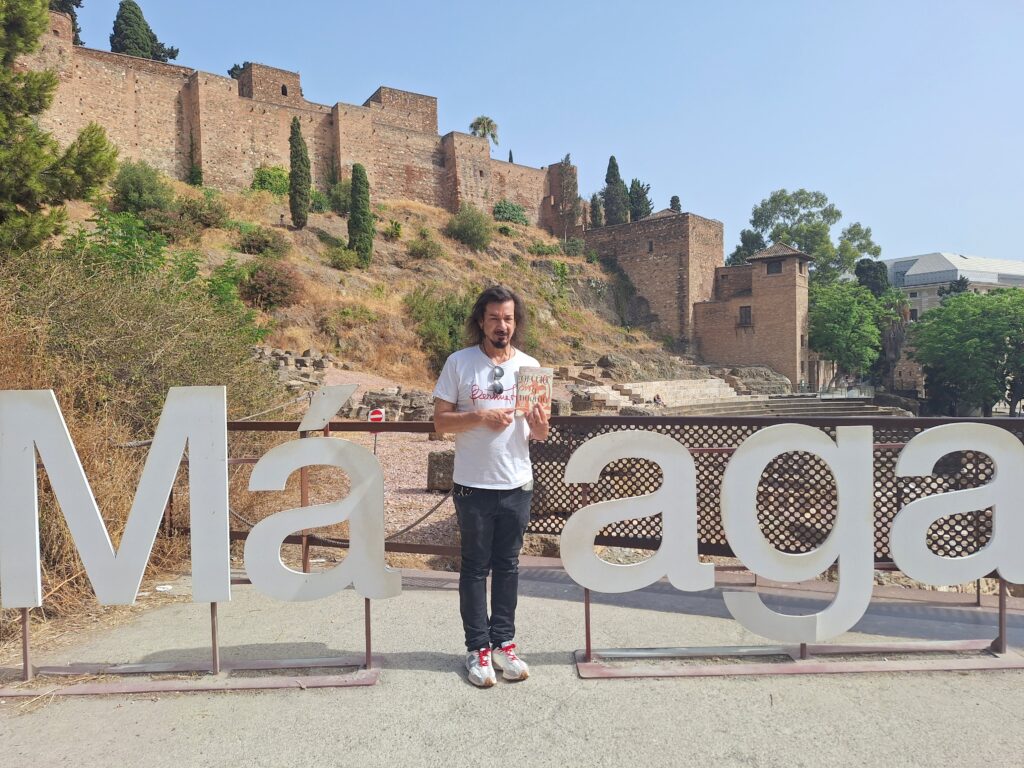
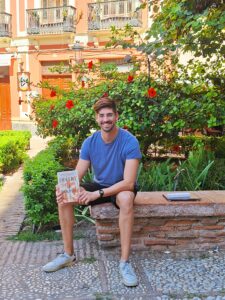
Sebastián, who has appeared in this blog before, is Chilean on his way to becoming a Spanish citizen. He’s been my Spanish teacher since I arrived in Málaga. From the beginning, we’ve only spoken Spanish to each other, although he’s fluent in English as well as in Russian and German. He studied filológia aleman (German philology) while attending university in Russia. So, yes, his German studies were in Russian (insert mind-blowing emoji). Among his favorite books are Sobre héroes y tumbas by Ernesto Sabato, La vida simplemente by Oscar Castro, and Nocturno de Chile by Roberto Bolaño. A book he recently enjoyed is Searching for Sappho by Philip Freeman.
Ofelia and Norma, Donna’s recent book, interests me a lot because it explores the subject of how relationships between people change when the circumstances that unite them change. Here we have two sisters and the circumstances for one of them have changed and later when they come back together, the relationship is not the same. Something has changed. It makes us think that this is life. Who hasn’t had a friend that one moment you’re vey close to and after a separation things are not the same? More or less, this is what the book is about and I think it’s very interesting.
Sebastián and I have had conversations previously about my book. He’s right. The book is in large part about relationships and how they evolve as a result of external circumstances but also through the characters’ internal conflict and its resolution. It’s about damage to a sisterhood bond and its ultimate repair through strength and self-actualization.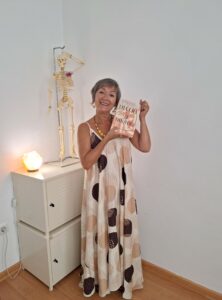
María is my excellent and lovely massage therapist. Originally from Madrid, she moved to Málaga several years ago. I see her monthly for my hip, worn out from over thirty years of running and, I suppose, ageing. She’s an avid reader and we often end our session talking about what books we’re reading. Among her favorite books are El infinito en un junco by Irene Vallejo, Hyperion by Dan Simmons, Mujeres de ojos grandes by Ángeles Mastretta, and La peninsula de las casa vacías by David Uclés. Vallejo’s book has been translated into English as Papyrus: The Invention of Books in the Ancient World. Uclés is only thirty-six and has racked up impressive awards as a writer, and is also a musician, illustrator, and translator.
And here, María makes an appeal to have my book translated into Spanish.
Hello, I would love it if this book Ofelia and Norma by Donna Miscolta were written in Spanish. Why? Because it’s written in English and I don’t speak English. I have been told of the subject matter, and it interests me a lot—family relationships and how they develop and come together, which in this case seems to be between two sisters. So I ask whoever is listening that this book also be in Spanish.
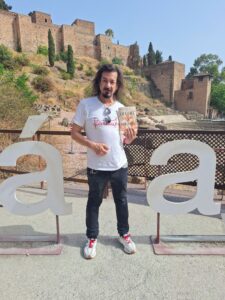 Pablo is originally from Granada but has lived in Málaga for twenty-five years. We met in the writers group that is mostly focused on works in English but has recently begun devoting an occasional session to works written in Spanish. A retired teacher of French and English, Pablo now records a biweekly podcast dedicated to travel and film. He himself dedicates much of his time to watching films, traveling, reading, and writing, sometimes all on the same day. On the afternoon that I recorded this video of him, we saw two movies. Both Spanish-subtitled movies involved a journey by car, the American film Omaha and the Japanese film Un taxi en Tokio. His list of favorite books runs to twelve, but here are the top four: Homage to Catalonia by George Orwell, El ingenioso hidalgo don Quijote de La Mancha (2ª parte) by Miguel de Cervantes, Le Rouge et le Noir by Stendhal, and Tristana by Benito Pérez Galdós.
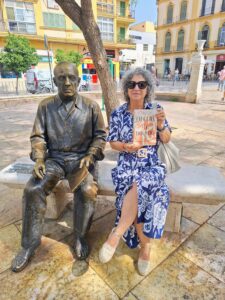
Hi, we’re here in Málaga, a city in the south of Spain—big, pretty, pleasant. It has an agreeable climate almost year-round. I have the great luck to hold this book Ofelia and Norma for the first time. The chapter titles look very interesting like this one: “Once, They Did the Can-Can.” I want to read it. I would love to read this book.
 I met Luisa last fall when I signed up for a creative writing workshop at the local library. I was the only non-local and the only one not a native Spanish speaker. It was a terrifying experience at times, but everyone in the class was friendly and kind, and very good writers. Luisa and I have kept in touch since the month-long workshop ended. Originally from Granada, she was trained as a teacher but preferred administrative work to the classroom. Retired now, she writes short narratives based on her family. She also tends to all the plants in the community spaces of her apartment building, including the terraza in this video. Among her favorite books are Atlas de geografía by Almudena Grandes, La sombra del viento by Carlos Ruiz Zafón, and Cosmofobia by Lucía Etxebarria.
Hi. Donna and I met in a writing class last year provided by the council of Málaga. I thought the stories she wrote were wonderful and from there our friendship began. Her latest book called Ofelia and Norma tells the story of twin sisters whose large bodies don’t conform to the cultural norms of beauty. As children they ignore what others have to say about them and are content with themselves. But when they’re in college their lives change radically. I won’t say more to avoid spoilers. I hope that soon the book will be translated into Spanish because I don’t speak English. But for those who speak English I recommend that you buy it and read it. And when it’s translated to Spanish, I’ll read it.
My deepest gratitude to my friends for their words of support. And to those words, I’ll add these:
Do you want to read, in Alex Espinoza’s words, a “fierce, unblinking portrait of rupture, return, and the radical power of shared vengeance”? Do you want a book that, in Erica Bauermeister’s words, “is destined to both break and mend your heart”? Do you want to, in Jen Soriano’s words, “get to know Ofelia and Norma, and to see them double down on their right to take up space as big brown women in pursuit of joy”?
It only takes one Yes. Preorder here.
Being one of the people fortunate to read the advance readers copy, I can testify this is a really wonderful book with rich layers of consideration for twins, sisters, body types, family expectations, and dealing with trauma. Congratulations, Donna, on this excellent new book. I thought about it a lot after finishing, which doesn’t always happen. Much food for thought. And translating into Spanish is a terrific idea!
Thank you so much, Marcia!
Thanks for this insightful blog….giving us a a picture of what it is like to take root in another country and follow one’s vocation.
Thanks, Phoebe. And then there’s also the perspective of Spaniards, who are very kind and welcoming but who also regret how tourism and the influx of immigrants like me have changed Málaga.
I enjoyed the videos in your blog, Donna. Did you know that August is Women in Translation Month? It was started in 2014 by Meytal Radzinski, a biologist and avid book blogger who noticed that fewer than 30% of all translated books were written by women. I hope all your books will be translated into Spanish (and other languages)! I’m looking forward to reading your latest book.
Thanks, Dale! I just finsihed reading a book by an Iranian woman translated to English. I do hope one day my books will be trnaslated into Spanish. Can’t wait to get your opinion of my new one.