Life in Málaga—Thoughts from the balcony
Spring is here, the weather is warmer and the beach beckons, the tourists are filling the streets and restaurants, and the cockroaches are back. Not in our apartment just yet, but in the building entrance and only corpses have been sighted, always with a leg or tentacle dreamily waving in the air, a taunt to the world from its stomp-resistant exoskeleton. These are the creatures that will rule the earth after humans have completed their destruction of it and departed for Mars.
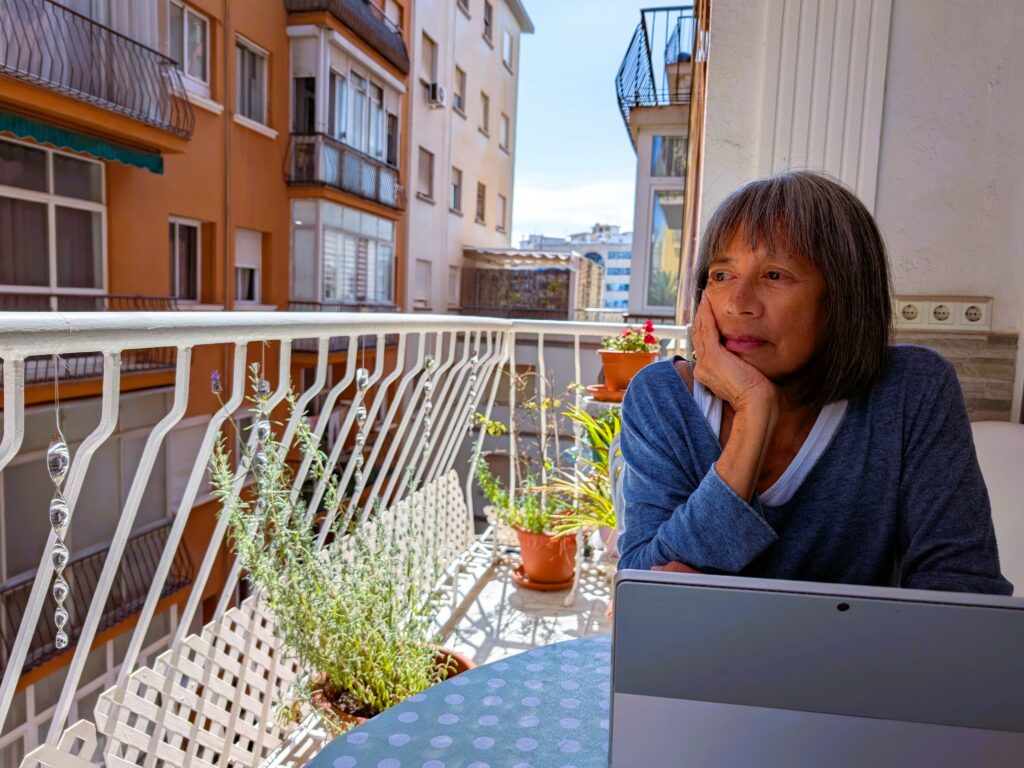
In the meantime, I’m spending part of my writing hours on the balcony. I repotted some plants, bought some flowering annuals for color, and hung reflective spinning, bobbing doodads to discourage pigeons or, more poetically in Spanish, palomas from roosting on the rail and dropping their shit. It sort of works. Noticeably fewer bird visits than before. Noticeably less bird crap. It’s a nice little human perch from which to consider the world passing below me as well as the things that tend to occupy me. Like books.
Forthcoming
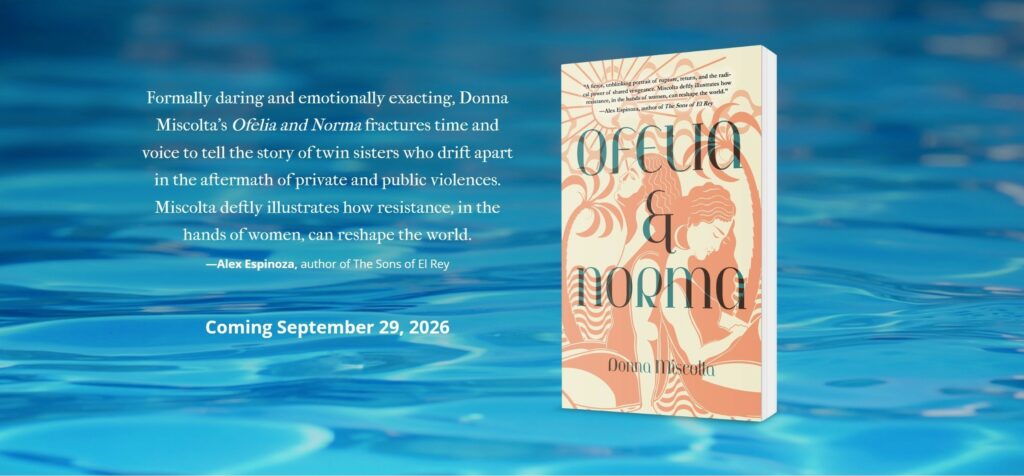
Anticipating the publication of a new book is both thrilling and laced with dread. Thrilling because after years of writing, revising, submitting, and collecting rejections like a hobby, your manuscript finally lands with a publisher. Laced with dread because after all those aforementioned things, you fear that nobody will care because of all the other books in the world flapping their pages for attention. But still, you timidly bang your tiny drum to cue whoever might be listening to preorder Ofelia and Norma. And you hope. And you tell yourself what is true. Getting the book out in the world is the point.
Because in the end, you’re a drop in the ocean, a grain of sand in the vast Sahara, the faraway twinkle of a star flaring its way to extinction. Because really, there are so many books out there in the world to choose from to read.
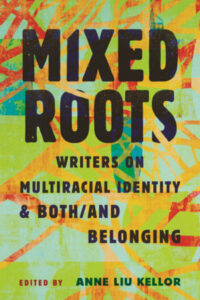 Another book among the multitudes that I hope you will choose to preorder is Mixed Roots: Writers on Multiracial Identity & Both/And Belonging, the anthology edited by the marvelous Anne Liu Kellor that consists of “29 personal essays exploring mixed identity, belonging, family, racism, community and the paradoxical ways of being in the world.” I have an essay in it on language loss due to assimilation and its recovery generations later. Mixed Roots will also be published this fall and the Seattle launch date is October 15 at Third Place Books Lake Forest Park. My Seattle launch for Ofelia and Norma is October 29 at beloved Elliott Bay Book Company. I’ll be in conversation with the (also beloved) sparkling member of the literary community Karen Maeda Allman.
In the works
I’m working on what I hope is the final revision of my next novel. (No title yet.) When my writing group suggested that a chapter in the middle of the previous version should be the opening chapter, I resisted. What ramifications would that have on all the subsequent chapters? What consequences on my brain? Surely, I could make the novel work without such a drastic change. But the fact is my writing group is smart and correct in many things. I joined this writing group over twenty-five years ago in Seattle. We meet online now, since only one of the current members still lives in Seattle. I’m very grateful to be in a group with Alma Garcia, Allison Green, and Jennifer D. Munro. So I excised that chapter like a steady-handed surgeon and transplanted it to the beginning of the novel. It looks like it’s working, folks. Still needs tinkering, but it’s getting there.
How to get book recommendations
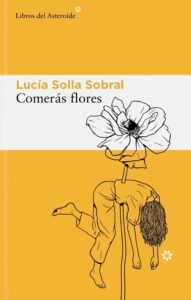 More book titles keep finding their way to my ever-growing to-be-read-in-Spanish list. My very no-nonsense massage therapist is an avid reader. Once after a session, I saw her pull a book out of her bag and so began a now routine post-massage chat about books. Among her latest recommendations is the non-fiction No hay dios (probablemente) [There is No God (Probably)] by Manual Saco. I, a non-religious person living in a country that extravagantly celebrates Semana Santa, am intrigued. Another recommendation is a novel that came out last year called Comerás flores (You will eat flowers) by Lucia Solla Sobral. I’ve been thumbing through it at my local bookstore to see how hard or easy it is for me to understand. I’m sure I’ll buy it next time I stop in at the bookstore. Nothing bad ever comes from buying a book.
We live in moments
I recently became friends with an upstairs neighbor. She’s in her mid-seventies, a few years older than I am. She grew up in Madrid but spent much of her adult life in Mallorca before moving to Málaga. We talked about books and movies and women’s lives over tea in her apartment. And because we are close in age, it was interesting to think about what each of us was doing at any one time in our separate countries with their separate and overlapping histories.
We went to the movies to see Calle Málaga, a story about a seventy-nine-year-old Spanish widow who lives alone on an old street in Tangier that bustles with vendors and shoppers where the Spanish and Arabic languages smoothly mingle. It’s a vibrant scene replete with sights and sounds so evocative you’re sure you can smell the geraniums that Maria Ángeles tends on her balcony overlooking Calle Málaga.
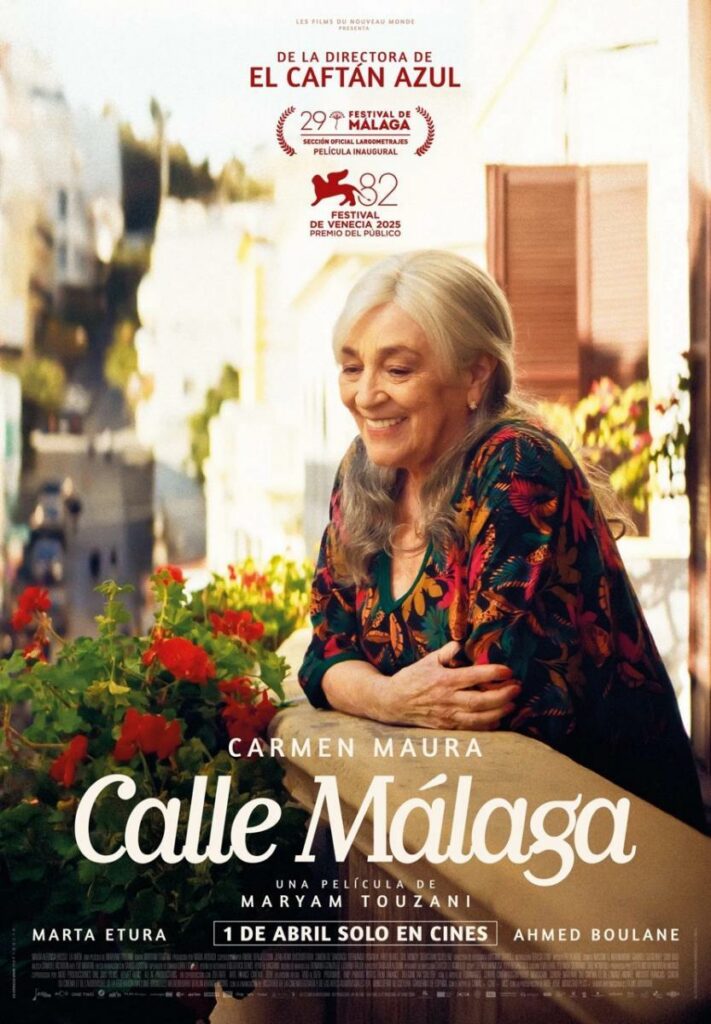
María Ángeles is played by Carmen Maura who early in her career appeared in many Pedro Almodóvar films in the ’80s, including Women on the Verge of a Nervous Breakdown. In a contemplative moment in the film, María Ángeles picks up a photo of her younger self (which is actually a photo of the young Carmen Maura) and gazes fondly at it, not wistfully as if she’s pining for her youth and regretting having aged in what could’ve been a cliché moment. Rather, she seems to be looking at an old friend, someone she was satisfied to have known.
After the movie, my friend and I had tea at a café, and we talked about the movie and then about our lives. Because like María Ángeles in the movie, we are mayores (elderly or elders), and like María Ángeles we are still engaged in life and learning, aware that there is less ahead of us than behind us. It was an afternoon of absorbing and telling stories, and I did it all in Spanish.
It all sounds lovely (well, not the cockroaches). Your persistence in writing novel after novel is inspiring!
I’m grateful for this life (that not even the cockroaches can detract from) and for the time to write!